
Bird Wise Observations: Birder Monique McClure
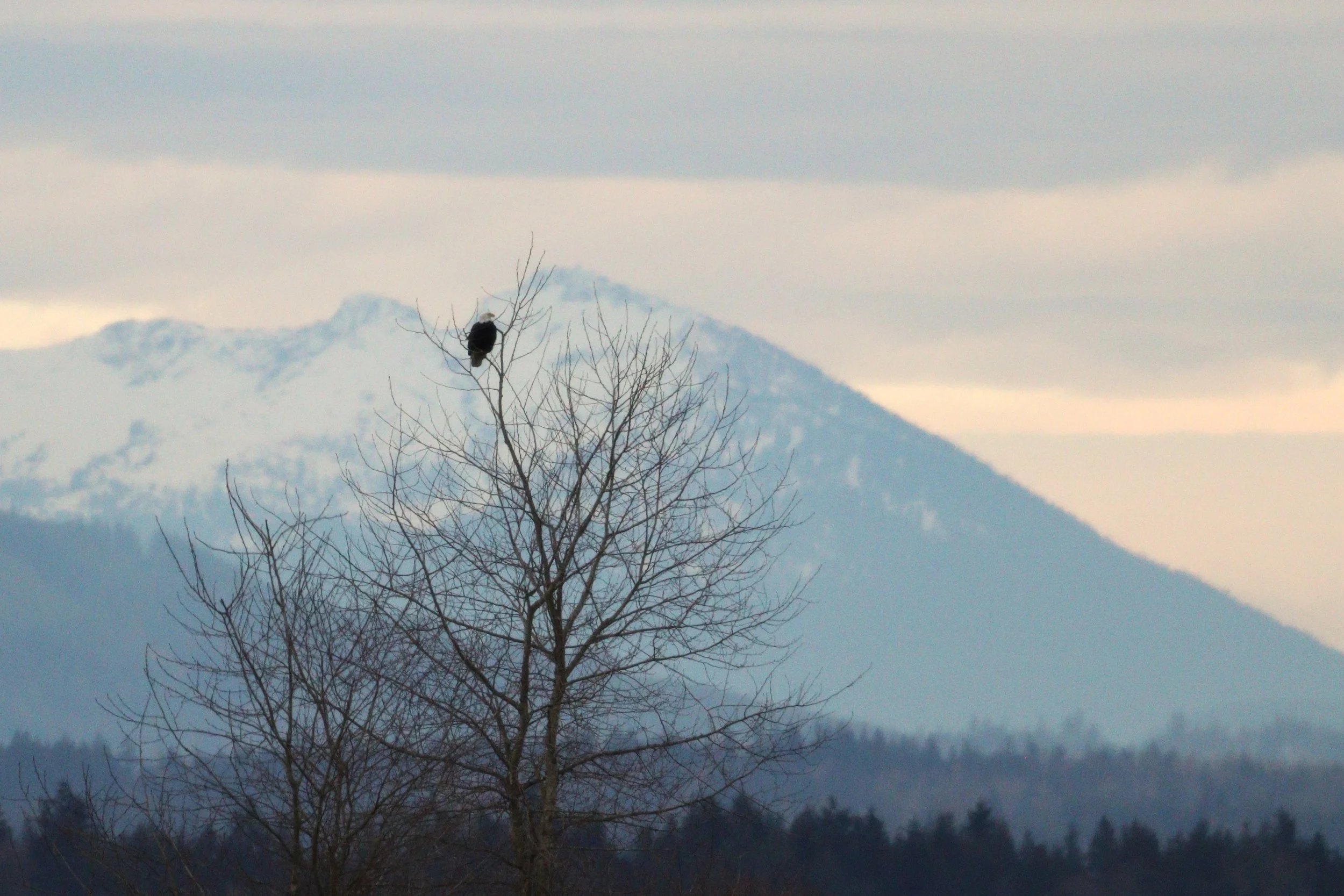
Bald Eagle (Photo: Monique McClure)
This month we talked with Monique McClure, a Seattle birder whose birding practice is informed by the built environment, and navigating the not-always accessible areas of Skagit’s birding spaces. McClure writes and consults on accessibility and disability inclusion. She advocates for accessible outdoor access at birding sites and charts the accessible locations she visits—as well as the birds she sees—on her Instagram, @moniquemcclurephotography.
I’ve been birding since 2016, and using the mobility scooter to bird since 2022. I experienced a foot injury in 2021, which changed my mobility. Now I use a scooter with off-road capability as the best tool for me to keep doing what I love. Everyone experiences a disability at some point in their life. For some, it’s temporary, for others, it changes over time, and for others, it’s permanent. I avoid saying “able-bodied” as it excludes invisible disabilities, and neurodiversity or mental health. If we are lucky enough to live to old age, it’s likely we’ll experience a disability at some point.
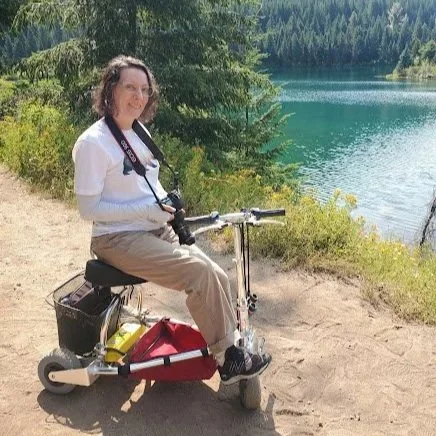
Monique McClure (Photo: Monique McClure)
Considering accessible trails and places to park a car while birding in Skagit became necessary when I went from walking as a birder to using a mobility scooter. I can walk the distance of about two city blocks before needing to sit and rest. If I need to move further than that, I use my mobility scooter.
I like to go to the Washington Department of Fish and Wildlife (WDFW) property at East 90 in Bow. February is a good time to go see the Short-eared Owls, as many photographers have had their fill and there are fewer people than when the owls first arrive in November. Hunting season is mostly over by February, too. It’s much easier to park on the side of the road with fewer cars. I usually go on Fridays because there are fewer people out birding and photographing.
At East 90 there is a wide shoulder, where there are a few spots to safely park. I can get out of my car and sit below the shoulder on the field side, on the grass. I wait and see what owls come in close. By later in the season, the owls are more acclimated to people, and one once landed 20 feet away from me, and we just looked at each other. It’s not unusual for the owls to land on the shoulder area later in the season.
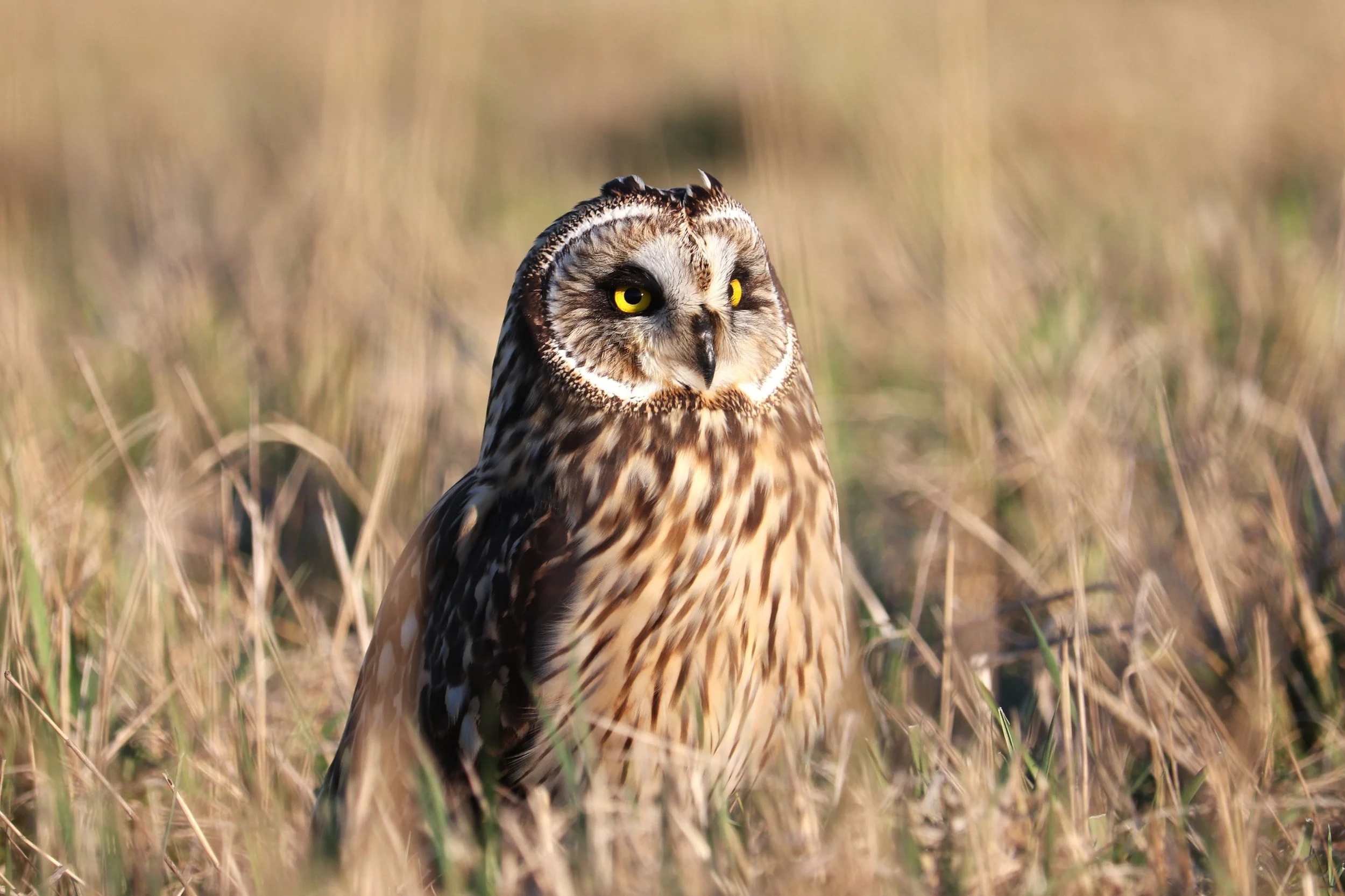
Short-eared Owl (Photo: Monique McClure)
My photos are a product of the type of camera and lens I used at that time. Most wildlife photographers have big zoom lenses. Mine was a beginner camera with a little 55-250mm lens, and the whole kit cost me around $400, used. That means I had two styles of taking photos available to me: Habitat, or close up, if the bird landed nearby.
Many people move around a lot to take pictures. I simply sit and wait for wildlife to wander by so I can get those close-up shots, and because I can't be walking around a lot. All of this sitting and waiting is totally fine by me. Some of the best experiences have been when birds just get used to my presence after an hour or two.
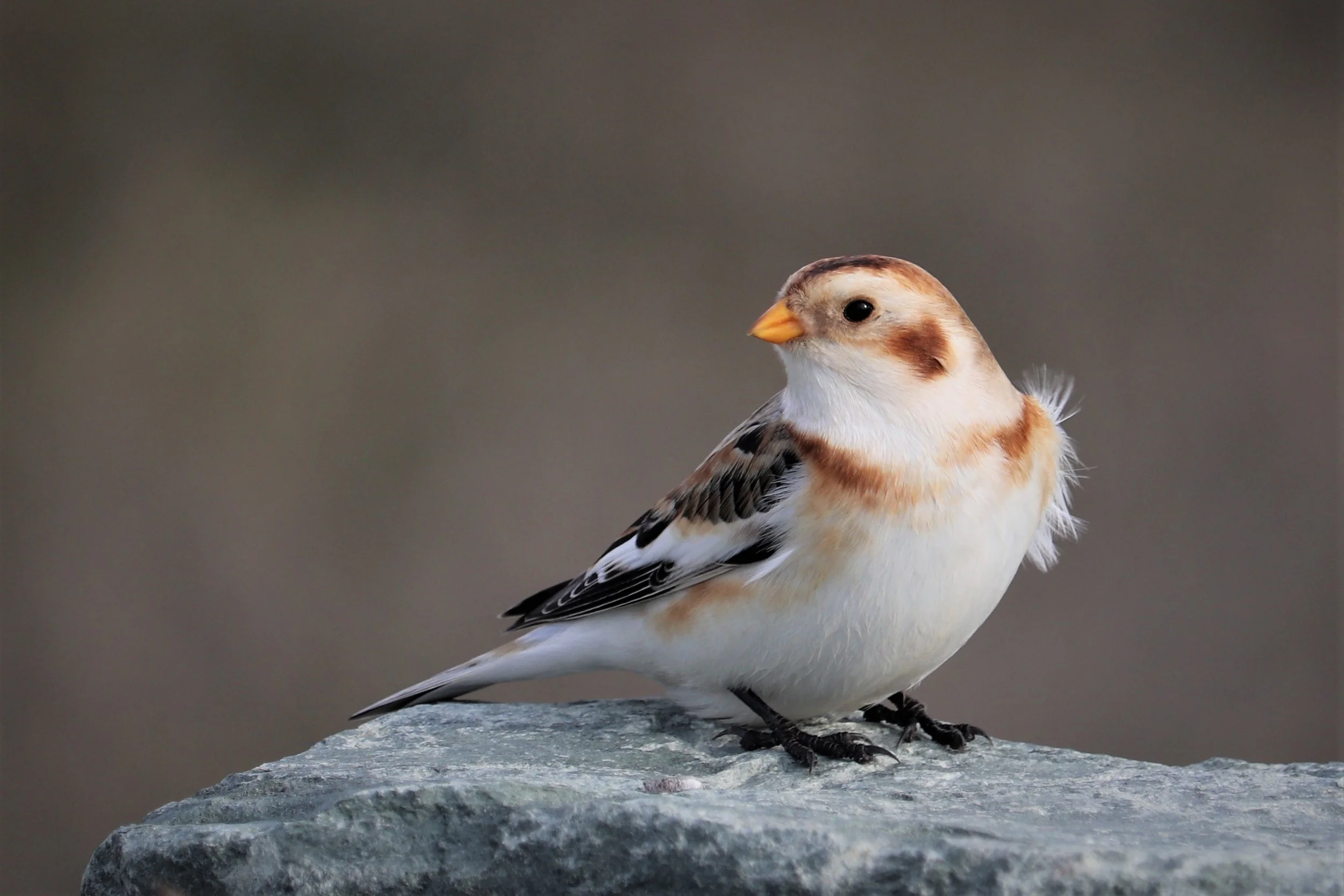
Snow Bunting (Photo: Monique McClure)
I saw a Snow Bunting at Eide Road in Stanwood in January 2021, using this method. It was reported as a rarity. At that time, I was not using a mobility scooter. The trail is generally accessible to those using wheels, such as a wheelchair, scooter, stroller, or bike, if the gravel isn’t loose from being recently replenished. I walked up and down the trail looking for the Snow Bunting and was successful. It wasn’t very shy, so we just watched each other. Not a single other person came by in those hours. It was a peaceful and delightful way to see this species for the first time in my life.
Sometimes I go to the dike at Rawlins Road on Fir Island, overlooking Craft Island and the estuary of the north fork of the Skagit River. I can walk up the slope there and bundle up in a million layers and sit in my camp chair for a few hours. I watch the birds fly over, Snow Geese in their massive V’s, Red-tailed Hawks, Northern Harriers, American Kestrels, sometimes even Short-eared Owls. It can be a great place to watch a sunset, too. It’s never my first goal to get a photo. It’s the time in nature and the time with just me and the birds, or other wildlife. Everything else melts away.
I have noticed changes in the Skagit birding scene over the years. While there are definitely more birders and photographers, fewer of them are venturing into the fields, in my observation. I think the local community in Skagit has educated visitors, especially new people, not to go into the fields. And other visitors are educating each other: I have seen people educate other users who were about to walk into a field, to point out signage or explain the rules.
I look at the fields in the WDFW areas like East 90 as the birds’ dinner table. I land on the side of not walking out onto the fields as a birder, even when it’s permitted. I don’t want to disturb the birds.
(WDFW posts signage indicating which areas are open and what types of access are allowed by season. Many areas are closed to the general public during waterfowl hunting season, typically September through January.) https://wdfw.wa.gov/hunting/regulations/migratory-waterfowl-upland-game
I’ve experienced impact from changes in the landscape of the birding areas over time as well. The parking lot at East 90 was a good idea, and it’s fine for car-birding, but its gravel is too loose and deep for someone using a wheeled mobility device. The lot is not near where most of the photographers gather, either. The only way someone like me could get back to the prime viewing area from the parking lot at East 90 is to use their mobility device along the shoulder, and that is potentially hazardous. Drivers there seem surprised by a wheelchair or mobility scooter on the shoulder, and sometimes they’ve driven erratically, which is an unnerving experience.
West 90 is fine for parking and car-birding, but there are not as many birds there. It has two designated parking spots that are van-accessible, and sometimes I use the short, paved trail to sit and watch for birds. WDFW put thought into that location, but for someone using a wheelchair or with limited mobility, the real birding is further out in the fields on rough trails. The hard-packed or paved trails at that location don’t go much beyond the parking lot.
The Fir Island birding areas are varied. Wiley Slough is not as accessible as it was before the restoration in 2024. I used to go there, both pre- and post-injury, and when I saw the signage about the forthcoming improvements, I thought, great! But the gravel there is too loose and deep for someone using a scooter or wheelchair. Sometimes late in the season the gravel has worn down to mostly packed dirt, which is temporarily more accessible, until new gravel is laid down again. The Fir Island Farm Unit is more accessible, some of it paved, and with several benches along the path out to the view of Skagit Bay.
Although there are not many accessible birding trails for personal mobility devices in the Skagit, it’s always a pleasure to visit Fir Island, Rawlins Road, and East 90 to bird from the car or find a seated place nearby. There seems to be a unique quality to the light in these places early in the morning and evening, which is great for photography. The opportunity to see raptors, and the occasional rare bird, keeps me coming back. The few times I’ve been able to talk with hunters have been great experiences. It’s always interesting to me to hear others’ perspectives on the landscape and birds. I always wonder what it’s like to live out there, because as a visitor, it does seem tranquil. It’s easy to become immersed, and let all the many demands of life just slip away for a little while.
As told to Bryony Angell. This interview has been lightly edited for length and clarity.
info@skagitonians.org