
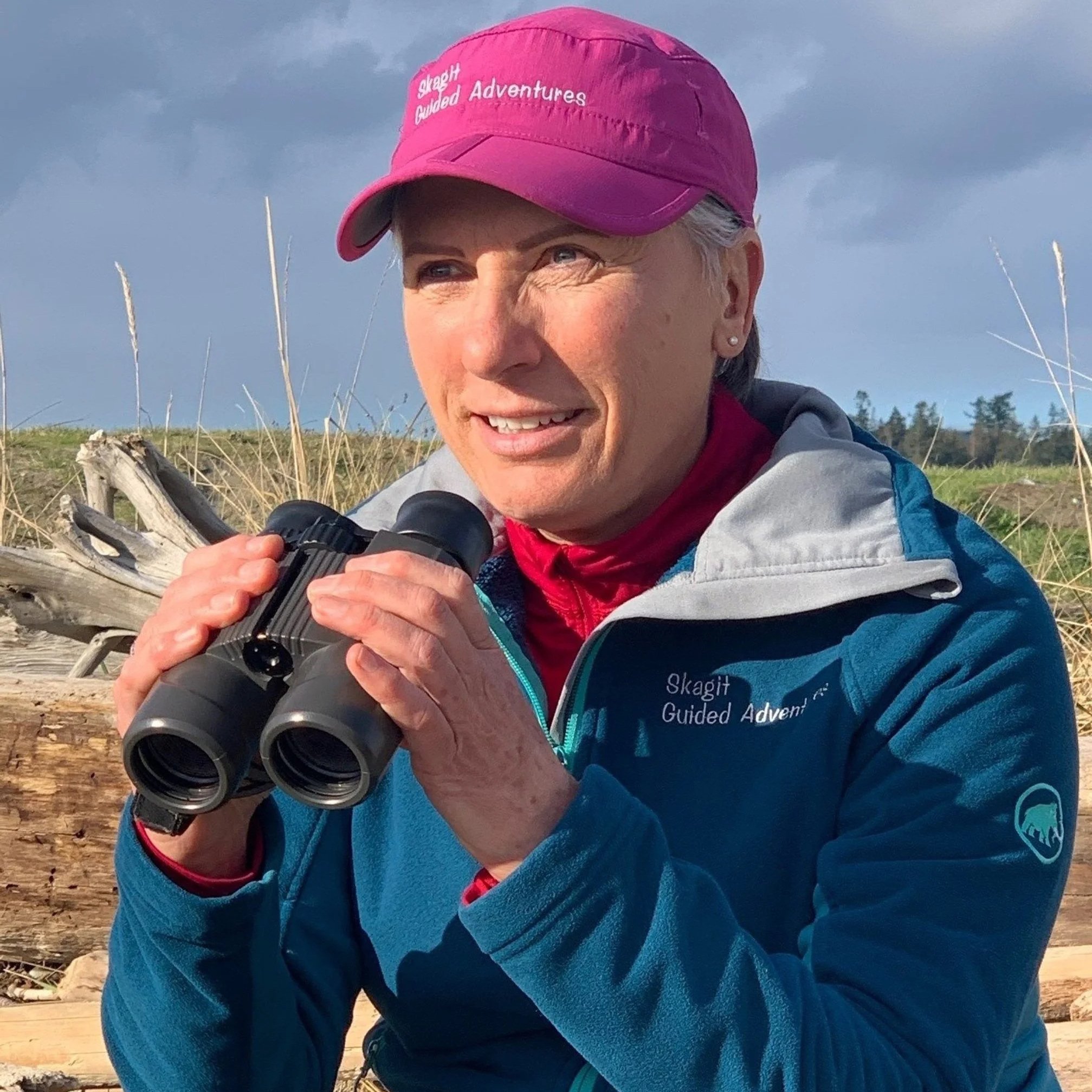
Stephanie Fernandez of Skagit Guided Adventures (Photo: Stephanie Fernandez)
Skagit-based tour guide Stephanie Fernandez has a story to tell: the origin of the Be Bird Wise campaign. Since 2016, Fernandez has led Skagit Guided Adventures, a small tour company specializing in Skagit County destinations, with an emphasis on natural history. Fernandez’s observations of visitor volumes and behavior over time played a role in the formation of the Be Bird Wise program. This collaborative educational campaign, hosted by Skagitonians to Preserve Farmland, promotes responsible behavior while viewing migratory birds on the agricultural landscape.
I guide tours in every season in Skagit, from land-based birding in the winter and spring, to tulips and other flower crops throughout the spring, to North Cascades hikes and birding by boat in the summer. I run day tours only, small groups of up to five people. Most of my guests are adults over 30, from outside of Skagit.
On my tours we bird watch, using the car as a blind. If we do get out, it’s a short walk to see birds, like the Hayton Preserve or East 90. Birding from a car is more practical for many reasons, such as mitigating weather and covering more places in the available time. Most importantly, birding by car is the least disturbing to the birds in the landscape. Birds are used to cars here.
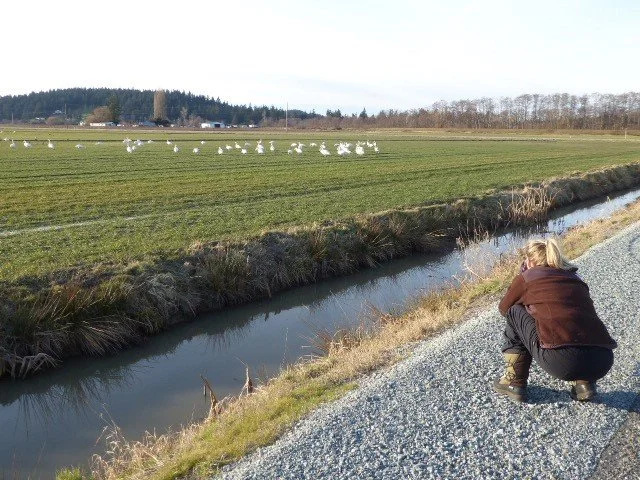
Birding from the shoulder of the road (Photo: Stephanie Fernandez)
Most of my birder guests are beginner birders. I love to show them how to use optics, look for field marks to identify birds, and what to listen for. Beginner birders are excited to see any bird; it’s all new to them. I show guests the farmland birds, seabirds along the coastal areas of Skagit County, and everything in between.
Swans are the most reliable of the local birds to stay in one place for a few days. They linger in the fields that have leftover potatoes from harvest, foraging. Other birds have particular daytime habits, too. Kestrels and other hawks are often easy to see perched on wires. And there is a place along the shoreline in Anacortes where Harlequin ducks gather every winter. As a guide, I pay attention to the patterns and changes of the bird life and the environment, to show people as part of their experience on a tour.
I look at the landscape for specific things as a tour guide. As someone who grew up in a big city, I had no clue about anything related to farming. When I first drove around Skagit farm country, I was impressed by how huge the agricultural area is. Not only is the landscape vast, but the amount of human and machine labor required to produce food really struck me.
I assumed the landscapes I was seeing were privately owned. There may not be signage indicating ownership, but my common sense told me to stay on the road shoulder and not go walking on fields—there was food growing in those fields!
As I was getting to know the area as a resident and guide, I worked at the visitor’s center in Mount Vernon and learned about the farm tour field trips hosted by Skagitonians to Preserve Farmland. I visited farms like Ralph’s Greenhouse and Washington Bulb Company on these tours and met the farmers whose land I saw from my car.
I’ve had guests ask, “Should I bring boots to walk in the fields?” I get this question often enough to wonder if visitors ask because of photos they’ve seen on social media of people in fields, close to birds. Photos on social media can be without context and often don’t show location either, but I worry the photos might show trespassing instead of responsible behavior. I assure my guests they do not need boots, we are not walking on fields, and mostly birding from the car. Any stopping and birding from the shoulder of the road is done safely and in areas where permitted.
I first noticed visitors walking in fields from the start of my tour business in 2016. When out with my guests, we would see other visitors venturing onto private property, maybe wanting to get closer to the birds for a photo.

Photo of undesired bird viewing behavior, for which the Be Bird Wise campaign was founded to address (Photo: Stephanie Fernandez)
In my observation, social media and its presentation without context has promoted misinformed behavior. I began to see more people wandering into fields after Covid, too. There seemed to be this coincidence of people wanting to be outdoors during the pandemic and sharing the experience on social media that led to an increase in the overuse impact on open spaces. Not just in Skagit but a lot of other places, too.
After three years of observing this behavior, I felt I had to say something, both for private property and wildlife. I approached Skagit Audubon in 2019, and then Skagitonians to Preserve Farmland (SPF), to see if there was an organized way of promoting responsible behavior from visitors here to see the wild birds. SPF agreed to host a discussion group, and brought in Washington Department of Fish and Wildlife, Western Washington Ag Association, and other agencies with a stake in the agricultural landscape that attracts the birdlife every year, to form Be Bird Wise.
The name Be Bird Wise came from my suggestion to the group that we might follow the example of the Be Whale Wise campaign here in the Salish Sea, in both premise and name: give wildlife space and be a responsible visitor in the landscape. And the name stuck!
I’m gratified by the work of Be Bird Wise since its inception. The organized group of collaborators got going after the pandemic, around 2022, with a website and code of conduct, attention from local media, a signage campaign, and a social media presence giving positive visual examples of ethical birding behavior, to counter misinformed images on the internet showing disturbance of birds and wildlife. All these little stepping stones to make a change.
It takes time for a campaign to change behavior, and bird patterns change over time, too. But overall, I have observed a decline in the kind of visitor behavior Be Bird Wise was formed to address, which is a good thing.
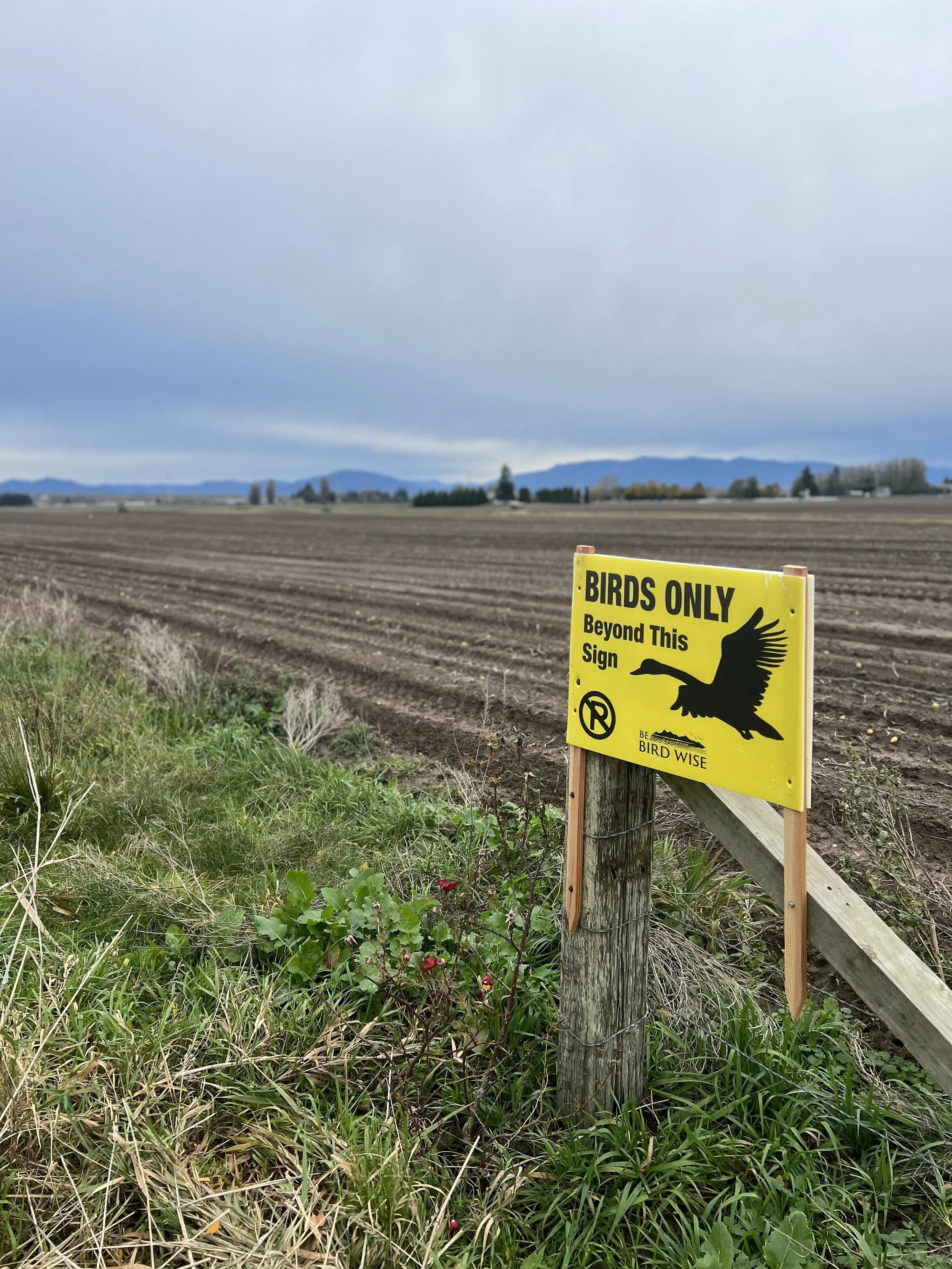
A Be Bird Wise sign along Best Road in Skagit Valley (Photo: Bryony Angell)
At the same time, I’ve noticed fewer of the birds that attracted the crowds of visitors, too. When I first started looking for swans and geese in 2016, there were more birds, and they were easier to find when I was scouting to come back later. Now I struggle to find them. I would hear and see many more birds flying over. Every year it seems there are fewer and fewer snow geese in Skagit. They may be distributing elsewhere, where there is more food. Many of the snow geese have moved to Eastern Washington for better forage (editor’s note: For more information about the impact of snow geese on an agricultural landscape, this story at Biographic provides an overview of the issues).
There is still incredible birding to be had in Skagit, and Be Bird Wise is a good foundation for any visitor seeking birds. As a guide, I find joy in connecting people to nature and enhancing their experience with my local knowledge of the Skagit landscape and biodiversity.
As told to Bryony Angell. This interview has been lightly edited for length and clarity.
Visit the Be Bird Wise website to read more community voices of the Wise Observations series, and familiarize yourself with the Be Bird Wise Code of Conduct for responsible bird viewing across the Skagit agricultural landscape.