
Wise Observations: Local Birder Colleen Shannon
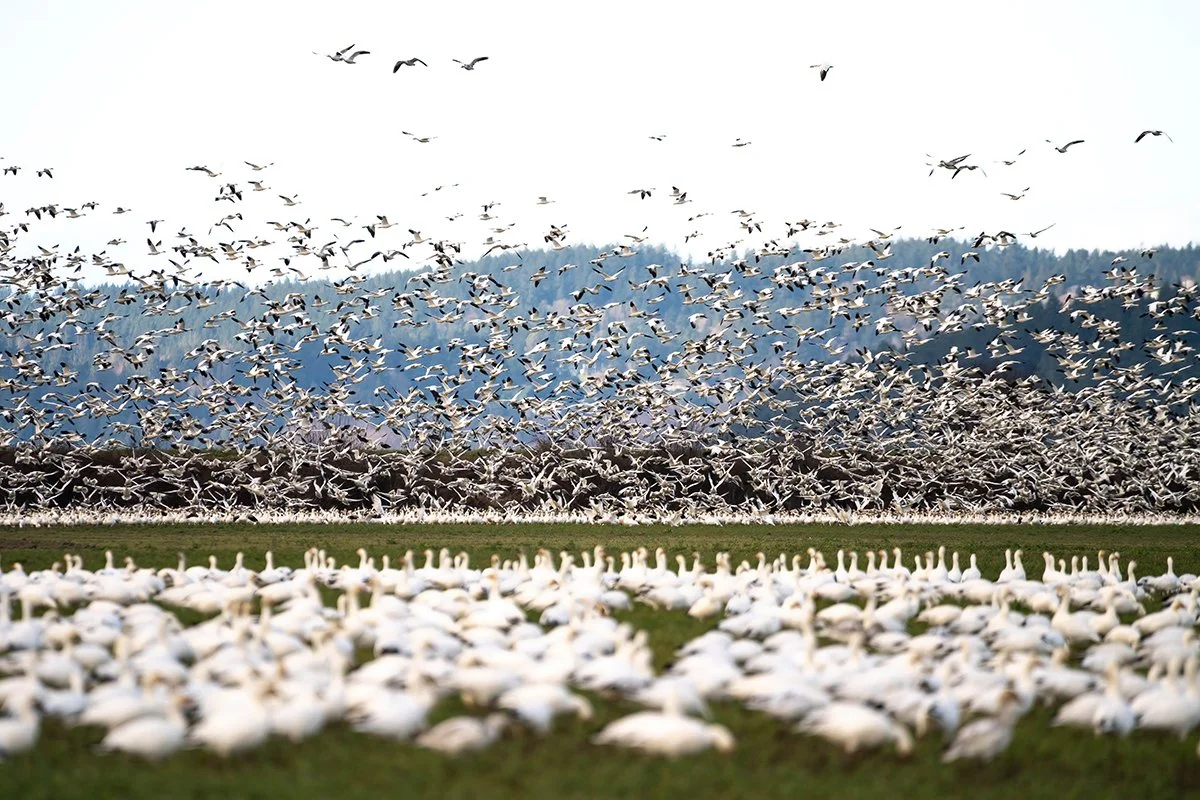
Snow geese on Skagit agricultural landscape (Photo: Cedarbrook Studio)
Be Bird Wise is an informational initiative of Skagitonians to Preserve Farmland and its agency and organizational partners across Skagit County to inform the public about the dynamic relationship between the working landscape and the wild birds that congregate here every year.
This month we talked with Colleen Shannon, a member of Skagit Audubon, one of the partner organizations in the foundation and launch of the Be Bird Wise initiative. She speaks from the perspective of an active educator for ethical wildlife viewing, with the wisdom of over two decades of observation of birding in Skagit. Along with her husband, Jeff Osmudson, Colleen is a frequent outreach face for Skagit Audubon at area festivals and events.
As a bird advocacy organization in Skagit, Skagit Audubon Society (SAS) supports education and messaging about how to ethically observe wildlife in all landscapes. Skagit Audubon has been a partner from the beginning in the development of the Be Bird Wise campaign, and promotes the message of Be Bird Wise in our outreach and at events. I am the Education chair for the organization so education about birding in Skagit is part of my outlook as a member.
The agricultural landscape of Skagit is especially critical for migratory birds, and the folks who visit Skagit to see the birds need to understand the connection between those birds and the working farmland.
I think of the message of Be Bird Wise as applicable to any place that has the challenges of human congestion resulting from rare bird sightings or birds in abundance. Be Bird Wise is an idea that translates to other places with the same issues.
My husband Jeff and I came into birding 25 years ago when he turned 50. We chose birding as an empty nest activity. My idea was ballroom dancing; Jeff’s was birding! We took Birding 101 at Everett Community College as a continuing education class. We were hooked.
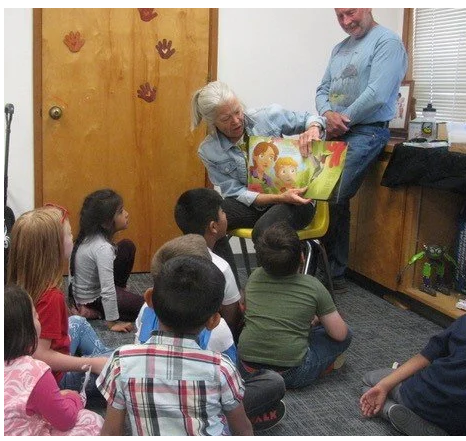
Colleen Shannon (with husband Jeff Osmudson) reading to children as part of Skagit Audubon outreach (Photo: Children of the Valley)
We wanted to be members of an Audubon chapter in the region, and we chose Skagit because we fit in well with this birding community. We tend to go north for everything anyway—the Skagit Food Co-op, Lincoln Theatre, birding. And being in north Snohomish County, we aren’t far from Skagit.
SAS is an all-volunteer organization. We keep our dues low so that cost is not a barrier to membership, and the organization does not budget for a paid executive director, as some of our surrounding chapters have done.
SAS has two to four field trips a month, as we can get volunteers to lead them. We also have a speaker series program as part of our monthly general meetings. The speaker series has been top-notch for a few years now. We have hosted avian ecologist and corvid specialist Kaeli Swift, artist and author Julie Zickefoose, and various ornithologists presenting on birds ranging from the locally declining Rough-legged hawk to owls. Most talks are hosted on Zoom, so anyone can join. You do not have to be a SAS member to partake.
The programs are listed on our website at skagitaudubon.org. Our in-person meetings are at the Padilla Bay Natural Estuarine Research Reserve in Bayview. We encourage all ages and abilities to join us. Our website is chock-full of information about our chapter, including suggestions of places to bird in Skagit County, like the Washington State Department of Fish and Wildlife (WDFW) managed areas at Wiley Slough on Fir Island, and East 90 on the Samish Flats near the town of Edison.
Our education programs are in high demand! SAS provides area libraries (Burlington, La Conner Swinomish, Mount Vernon, and Sedro Woolley) with birding backpacks, which contain binoculars, a field guide, and a birding map of Skagit. Our programs are age-specific and range from classroom activities like display boards of bird feathers and skulls to outreach at festivals and events. We also lead bird walks around Skagit, both scheduled and by request.

Birders at Skagit’s Padilla Bay Dike Walk (Photo: Amber Phillips)
Just this week we’ve had requests for programming from local summer camps, and a 4th grade class in Anacortes. I lead the group of volunteers who deliver programs to the community: to homeschool groups, scouting troops, after-school organizations, and various adult groups and clubs. We educate audiences about the bird species seen in Skagit, how to look for birds in whatever space you are in, and good birding manners. The kids especially respond to the messaging about exercising good birding behavior. They say, “Of course you don’t want to bother a bird!” The hope is that the kids will go home and tell their parents about birds and birding manners.
I wish I could say adults show good birding behavior after they have been informed. We’ve taken people out and explained birding etiquette. Then not even five minutes go by, and someone from our group disregarded our instructions and walked through a campsite to get closer to a bird to take a photo.
For the most part it is the small, small minority of birders who demonstrate this behavior. Most SAS members are so respectful of the birds and private property. We just repeated the message to this one person on that occasion.
To me, it was unnerving to see an adult, disregard instructions to get that one photo. As representative birders, we repeat the message over and over and hope it sinks in.
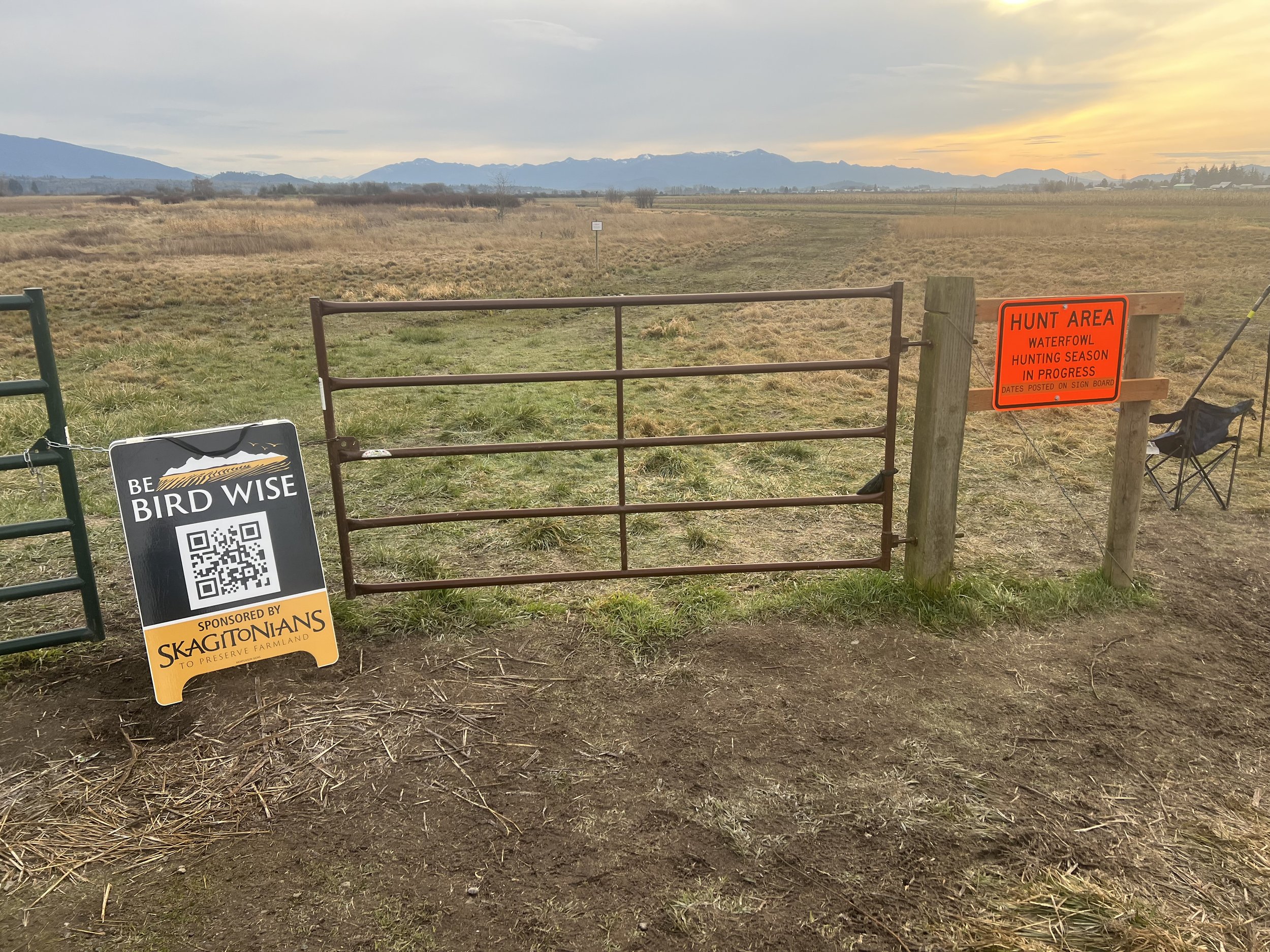
A popular spot for birders: The East 90 WDFW preserve near Edison. Skagit Audubon and Be Bird Wise both promote respectful observation of wildlife across the working and public landscapes of Skagit (Photo: Bryony Angell)
The conflict identified by the Be Bird Wise coalition around 2020 was between farmers and recreational bird enthusiasts not showing good birding manners. Back then, Fir Island consistently hosted snow geese on its fields. The geese became an attractive nuisance to the farmers because of the visitors drawn to see them. It was the same time as the Pandemic and many people were looking for outdoor recreation they could do safely away from other people. Birding grew in popularity at this time.
I now observe fewer of the birds that used to draw the big crowds. I’ve recorded species driving across Fir Island the last few years and rarely see the kinds of snow goose numbers on the fields there that we used to see. Martha Jordan, a swan biologist, shares a lot of information about snow geese, too, and she reports that more snow geese gather in eastern Washington now. It could be because of the decline of dairy farming in Skagit; fields that used to produce silage are now growing other crops less preferred by those birds.
Jeff and I were in Othello, Washington, in March 2025 to see the Sandhill crane migration, and we saw a raft of 60 thousand snow geese on the reservoir there! They fly over in huge flocks, like they used to in Skagit.
No matter the volume or frequency of bird populations, it’s still worth it to teach birding ethics.
They ought to be common sense: Do not trespass on private property or block driveways. Pull completely off the road. Just be thoughtful and respectful of the creatures and the private land-owners. It is pretty basic and it helps birders and land owners be on agreeable terms.
Birding is always a huge thrill. I love to be on the delta, watching a cloud of snow geese or swans in the sky or just above the fields as they land like snowfall. These birds are a visual wonder. I would miss them if I lived anywhere else.
As told to Bryony Angell. This interview has been lightly edited for length and clarity.
info@skagitonians.org