
Bird Wise Observations: Waterfowl Biologist Martha Jordan
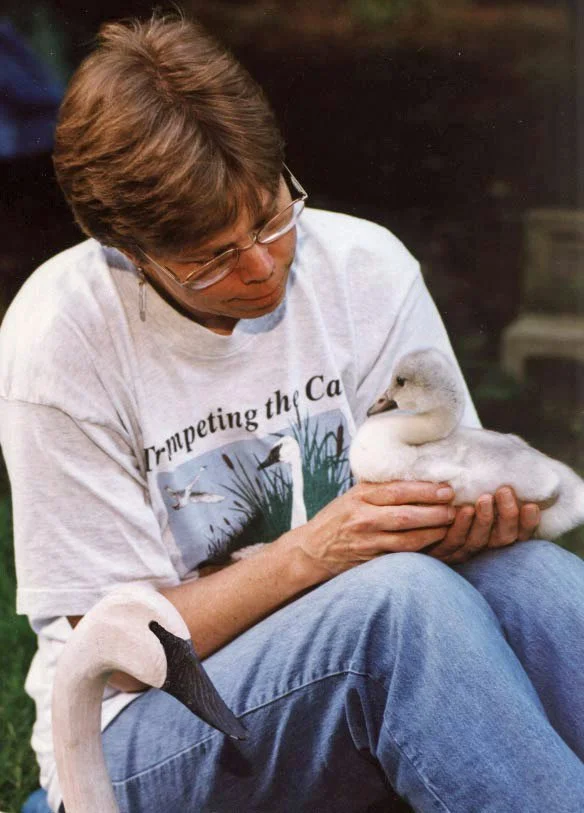
Martha Jordan and cygnet (Photo: Martha Jordan)
This month we spoke with Martha Jordan, a waterfowl biologist whose career has taken her across Washington and Alaska. Since the 1970s, she has led Trumpeter swan surveys, authored Washington’s first Trumpeter Swan management plan in 1985, and now directs the Northwest Swan Conservation Association, focusing on swans and habitat conservation in the northwest of the U.S. She’s observed Skagit’s swan populations for decades as Washington’s authority on this impressive bird.
I observe swans are an ambassador to find common ground. Everyone loves swans. Swans have connected me with different groups: city, county, and state governments, wildlife agencies, public utility districts, animal rights activists, private landowners, the media, hunting groups, and more. I have swans to thank for a career of learning opportunities.
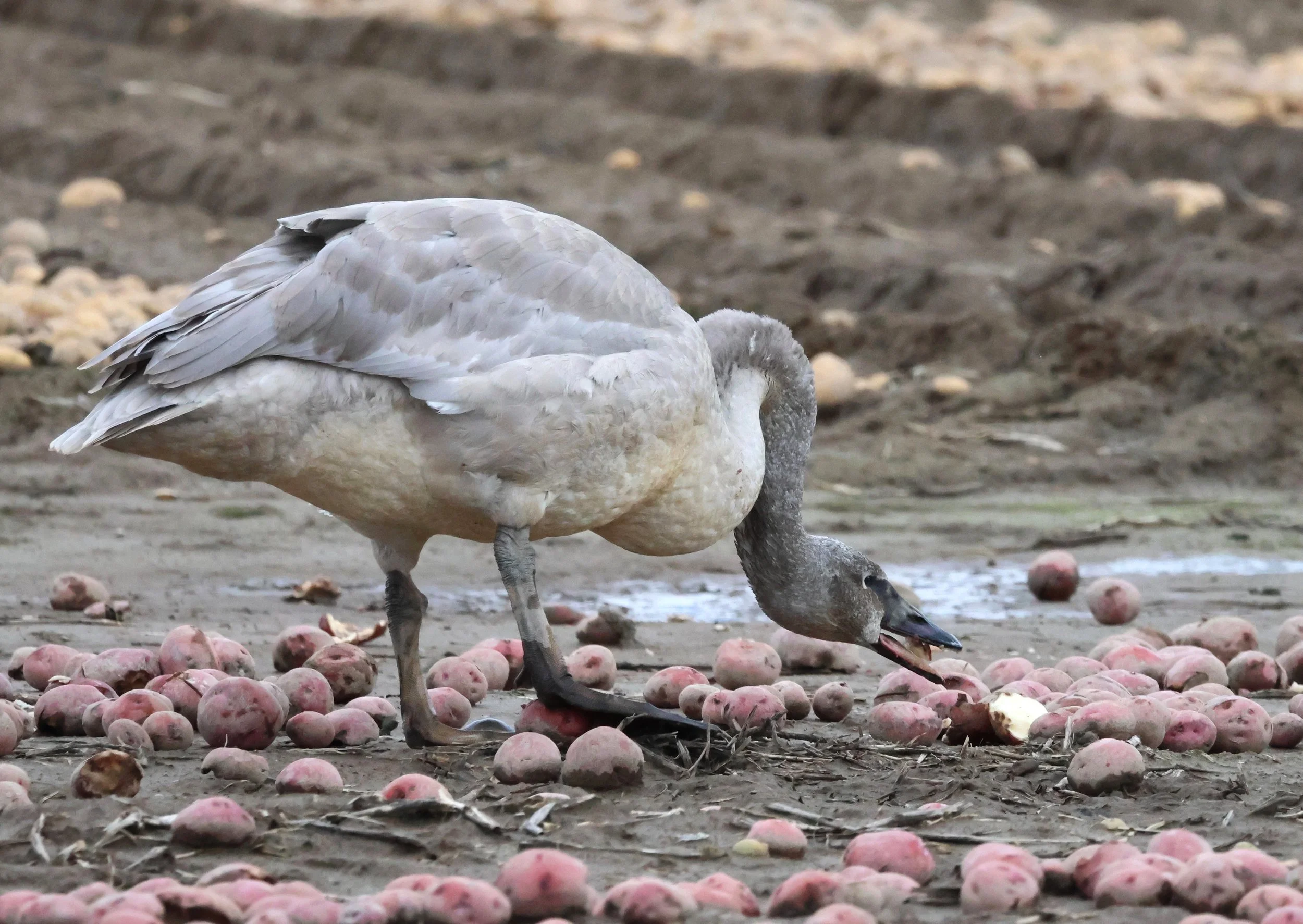
Trumpeter swan eating potatoes (Photo: Kim Cashon-Smith)
I began my waterfowl career in 1974, observing collared snow geese in the Skagit Valley for Russian scientists. These scientists were putting collars on snow geese on Wrangel Island, Russia, the breeding grounds for these geese. I was one of their volunteers in Washington reading those collars. Back then, there weren’t as many snow geese in Skagit Valley as there are now, and American and Canadian wildlife biologists were concerned about them from a conservation perspective.
Now, the Wrangel Island snow goose population has recovered. Colored neck bands are now supplemented by satellite collars giving more information about a bird’s migration and seasonal location. We now know all the snow geese that winter in Skagit Valley breed on Wrangel Island.
I observed neck-banded Trumpeter swans in Skagit Valley at the same time as my volunteer work observing snow geese. Like snow geese, fewer swans wintered in Skagit Valley then. Similarly, we didn’t yet know the swans’ origins or migration routes.
In Fall 1975, I observed 15 to 20 swans in the Skagit Valley with color-coded collars. These birds had been banded somewhere in Alaska and wintered in Skagit. Coincidentally, I was in Alaska the following spring of 1976, driving between Kenai and Anchorage, and I saw those same swans with the collars near Sterling Alaska on the Moose River—the exact same birds I’d seen in Skagit just months earlier!
That Alaska swan sighting started my path to becoming “the swan lady” in Washington state. I started a volunteer swan survey project on the weekends in Skagit Valley. We collected data on Trumpeter swans for six years, watching their numbers increase every winter. In partnership with Washington State Department of Fish and Wildlife (WDFW), the swan survey expanded to all of Western Washington in the early 1980s. I traveled around Western Washington, counting swans and documenting their locations. In 1984, WDFW asked me to write up my information and thoughts on Trumpeter Swans in Western Washington. I did, and this effort was published as the Trumpeter Swan Management for Washington State in the Pacific Flyway Trumpeter Swan Management Plan.
The Trumpeter swans in Skagit Valley are the Pacific Coast population, migrating to the Skagit Valley from Alaska and British Columbia. Swans have fidelity to their wintering grounds. They are in the Skagit Valley because of waterfowl-friendly agriculture, and adjacent ponds and wetlands for night roosting.
What caused the numbers of Trumpeter and Tundra swan to increase in Skagit Valley in the 1970s? It appears dairy corn is the primary driver for the increase in swans in Skagit Valley during the 1970s-80s. In talking to elder-generation Western Washington dairy farmers, I learned about the switch dairy farmers made from a corn variety grown for silage, taking 105 days to mature, to a variety that only took 84 days. A shorter growing season allowed for corn to form mature kernels. Better for cows, and the post-harvest corn left in the fields turned out to be well timed for hungry migratory waterfowl, swans included.
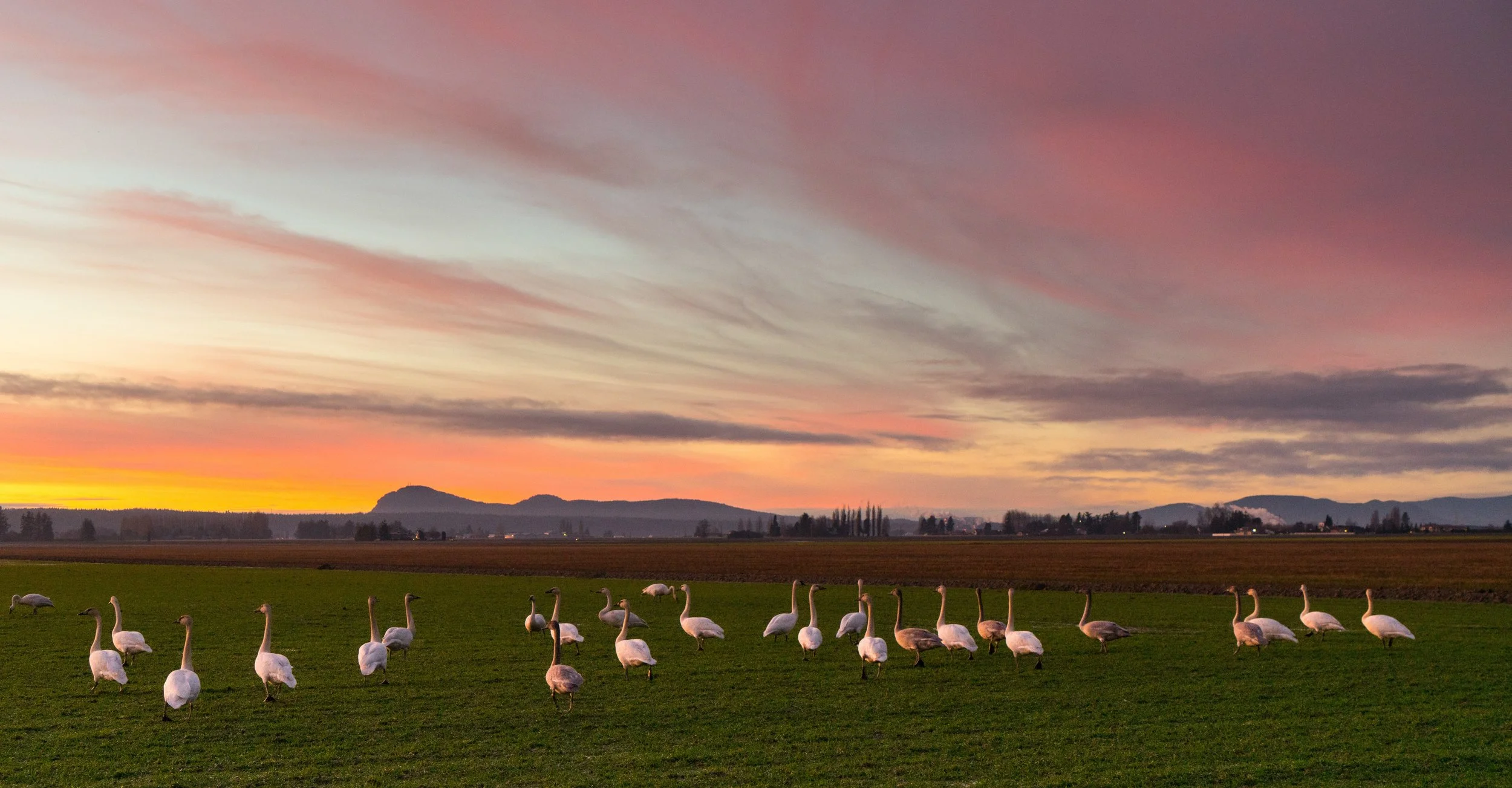
Swans in Skagit Valley (Photo: Gary Brown)
Birds are still drawn to natural areas like wetlands, but wetlands alone can’t sustain the volume of birds we see in Skagit. Agriculture is the critical habitat draw for birds: We have farmers to thank for that.
Crop rotation and shifting crops to something new can also mean a shift in bird population and movement throughout the Valley. A field might grow pasture grass one year, and the next year grow Brussell sprouts—the latter has no food value for waterfowl—the result is the bird distribution and numbers change from year to year.
And more recently, we’re seeing a decline in the specific agriculture swans and geese rely on: field corn grown for dairy cows. Regulations and changes in market demand means dairies are closing in Skagit, or moving to Eastern Washington (editor’s note: to learn more about dairy farming in Skagit, read our earlier story, “Making Dairies Work in Skagit Valley). What used to be dairy might now be hazelnut orchards or blueberry farms, again, crops with no food or habitat value to waterfowl.
The most visible shift in bird population in Skagit is the change in snow goose numbers. Skagit had 138,000 snow geese counted in the 2022 season. This year, for 2025/2026 winter, the count is about half. Over those same years, the number of snow geese in Eastern Washington’s Columbia basin increased. The significant changes in agriculture on both sides of the mountains has led to this winter snow goose population shift.
We don’t know yet what will happen with the swan population. Skagit Valley still hosts the largest concentration of wintering Trumpeter swans in North America. Swans are not able to move as readily as snow geese, with habitat changes. The Skagit swans will not go to Eastern Washington. They may end up further south in Chehalis, or stop short in British Columbia.
We still have potatoes and several other waterfowl-friendly crops in Skagit. A friend and I were watching swans gathered in a field full of cull potatoes. People in cars, and even a pair of cyclists, stopped for the swans and potatoes. A couple of people walked into the field to grab what they saw as free food. They trespassed onto private property, disturbed the swans, and intended to glean potatoes covered in swan excrement! Multiple offenses, though they disregarded us when we commented they were trespassing. A Be Bird Wise sign along the road at that field would have been a good deterrent. As an educational tool, the signs come in handy on the side of the road when there are birds in a field and people stopping.
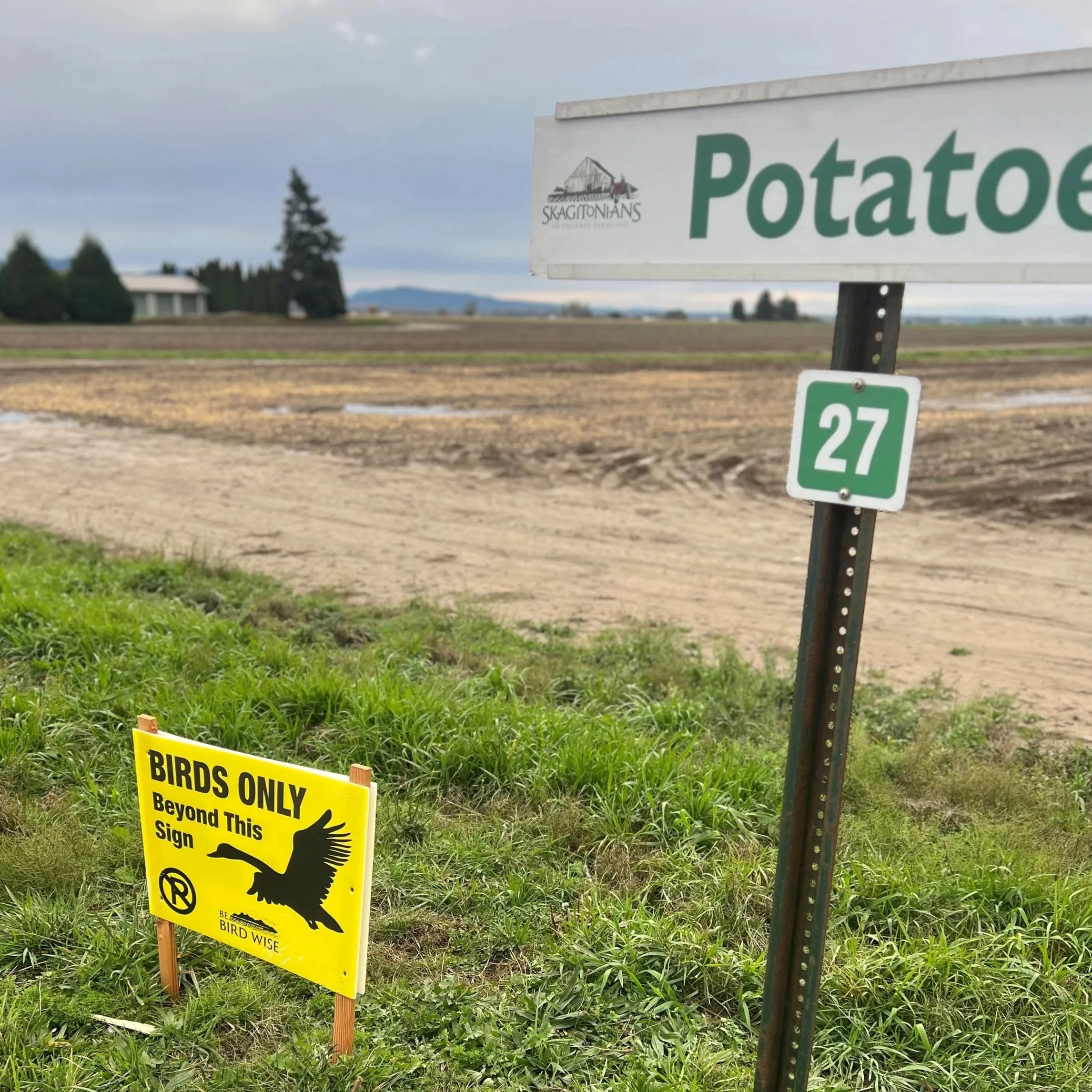
A Be Bird Wise sign posted beside a potato field in Skagit Valley (Photo: Bryony Angell)
I am happy to have Be Bird Wise as an educational program in the community. There have always been visitors to Skagit, some who trespass and most who don’t. There were fewer people years ago, and disruptive behavior was less. Now, with more people visiting, there is a greater volume of misbehavior.
When trespassing happens, it’s sometimes to get closer to birds. Disturbance of birds isn’t just disruptive, it’s potentially lethal. Those fields where swans forage are often surrounded by power lines of varying voltage. Swans trying to fly with a shorter take off distance between them and power lines may and do collide with those lines, often fatal for the swan. I’ve worked with electric utility districts in Whatcom, Skagit, and Snohomish counties to have avian diverters put on power lines. You now see them all over Skagit, those little hanging reflective markers on the lines as you drive along. These are very effective in helping birds avoid the power lines.
The best way to visit Skagit to admire the swans, snow geese, and other birds, is from your car. If you pull over, do so well away from farm buildings or driveways, keep an eye out for “No Parking” signs, and if you are asked to leave by the local landowners, move along respectfully (editor’s note: Do not leave your car unattended if you are on the shoulder, farm equipment has right of way and is impeded by cars on the shoulder. See Be Bird Wise Code of Conduct). Visit public natural areas like The Johnson Debay Slough Swan Reserve in Mount Vernon, where swans stop over or the Hayden Snow Goose Reserve on Fir Island
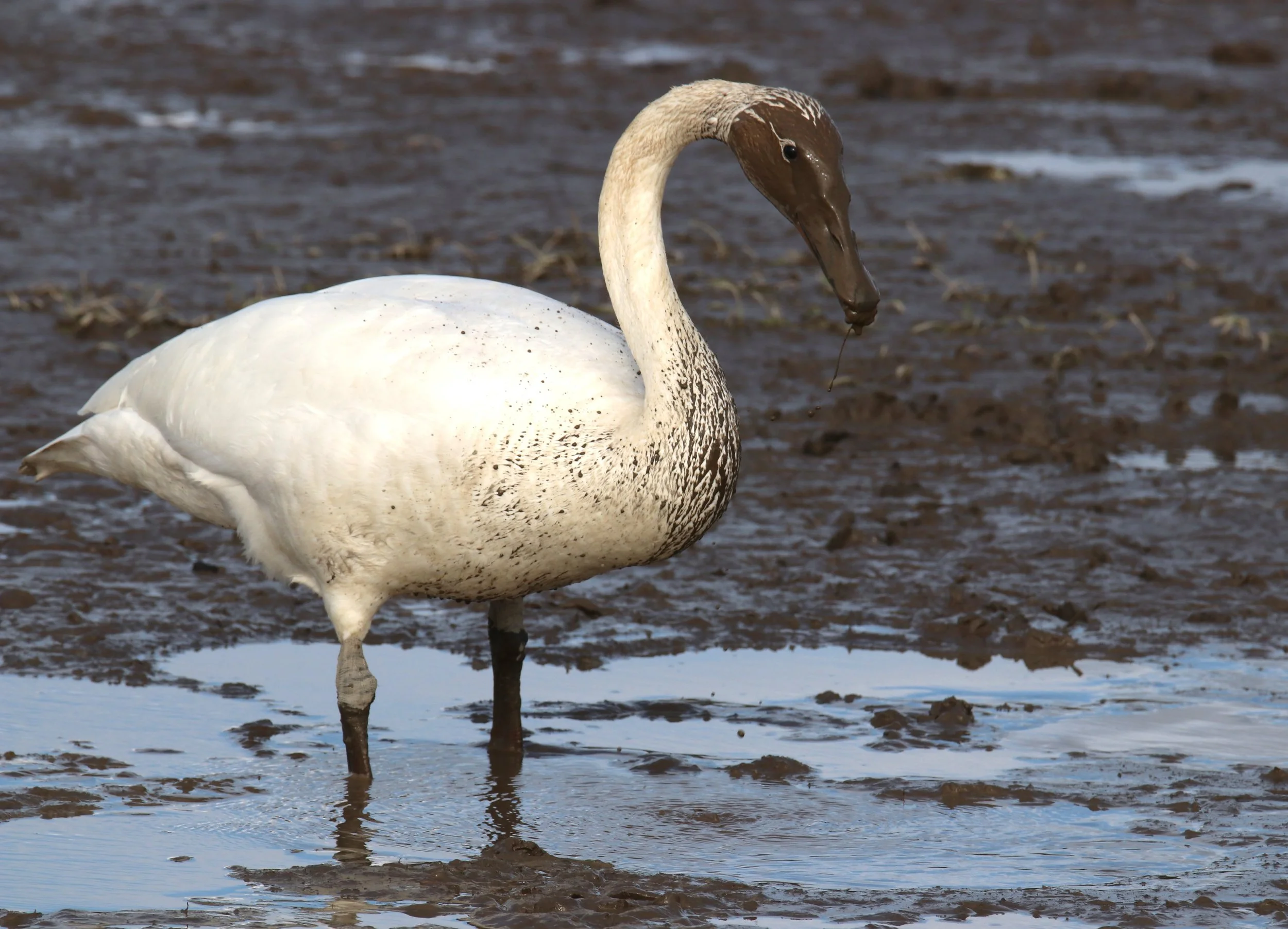
Swan in mud (Photo: Kim Cashon-Smith)
I also see swans along quieter country roads. At Stackpole and Dike roads, I’ve watched swans feasting on potatoes, the birds not 30 feet from my car. They’re covered in mud so thoroughly you can only see a bit of white on their bodies, heads, and necks covered with chocolate brown mud; but you can tell they’re swans! With my car window rolled down, I sit and watch and listen, the slap of their big feet as they move around, their slurping sounds as they eat. It is pure joy to witness and share a moment with the white birds of our winters.
As told to Bryony Angell. This interview has been lightly edited for length and clarity.